Purpose of This Resource
This document provides a structured reference system for fabric selection in machine embroidery, including compatibility with needle, thread, and stabilizer configurations.
It is designed to standardize decision-making and reduce common embroidery failures through system-based setup.
For related systems:
- Thread selection → Embroidery Thread Guide
1. Fabric Classification System
Fabric behavior under stitch stress determines embroidery outcome. Classification is based on structure, density, and elasticity.
1.1 Stable Woven Fabrics
Examples: Cotton, linen, canvas
Characteristics:
- Low elasticity
Configuration:
- Needle: 75/11
1.2 Dense / Heavyweight Fabrics
Examples: Denim, twill, heavy canvas
Characteristics:
- High penetration resistance
Configuration:
- Needle: 80/12 – 90/14 (sharp)
1.3 Stretch / Knit Fabrics
Examples: Jersey, rib knit
Characteristics:
- High elasticity
Configuration (mandatory):
- Needle: Ballpoint
Improper stabilization results in distortion.
1.4 Lightweight / Delicate Fabrics
Examples: Silk, organza, chiffon
Characteristics:
- Low fiber density
Configuration:
- Needle: 65/9
1.5 Synthetic / Semi-Stable Fabrics
Examples: Polyester, blended fabrics
Characteristics:
- Moderate stability
Configuration:
- Needle: 75/11
Thread compatibility should be verified.
2. Fabric Selection Decision Framework
Apply the following sequence:
Step 1: Identify Structure
- Woven → Stable
Step 2: Evaluate Density
- Lightweight / Medium / Heavy
Step 3: Apply Configuration
- Needle selection
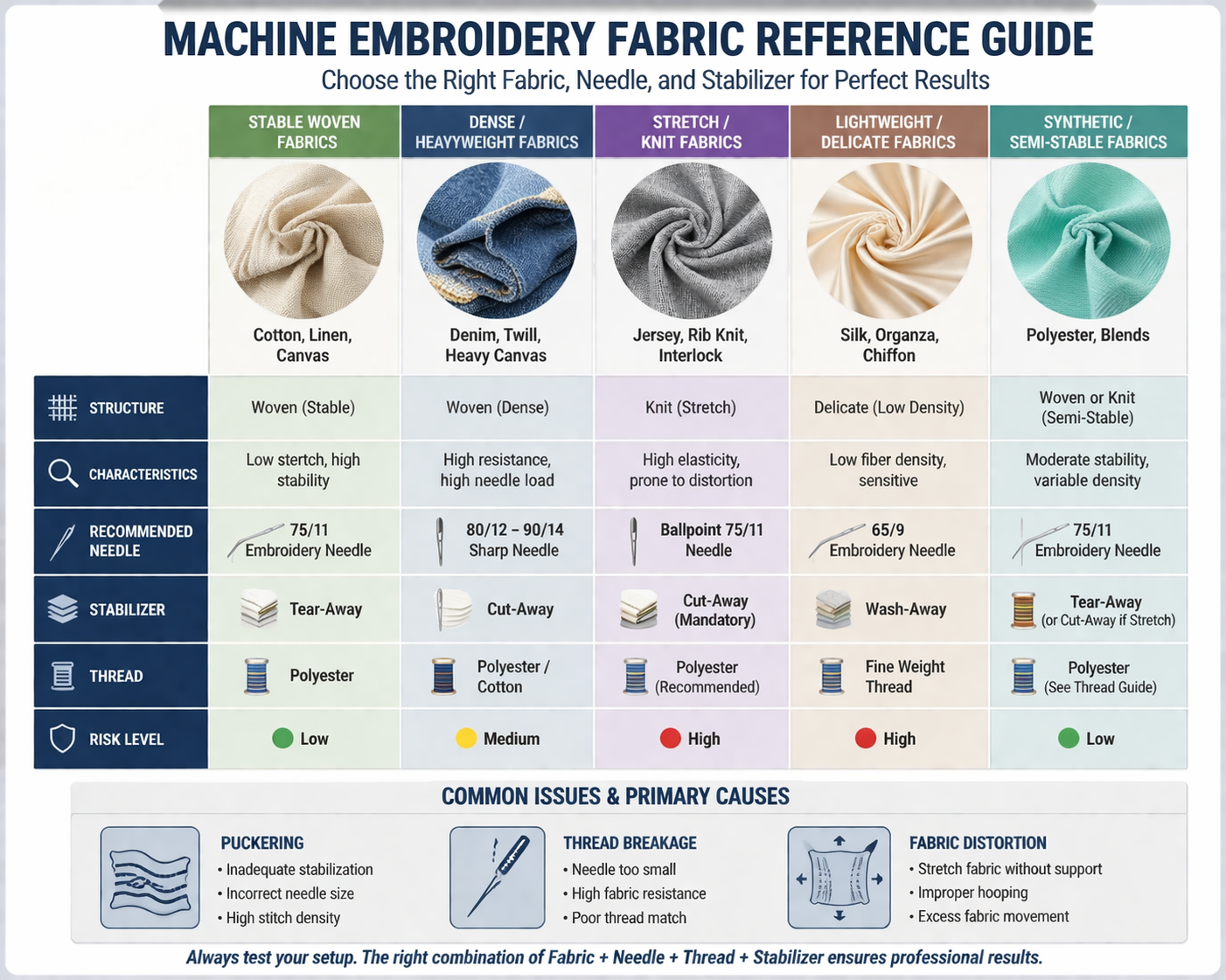
3. Fabric Compatibility Matrix
| Fabric Type |
4. Failure Pattern Analysis
4.1 Fabric Puckering
Primary Causes:
- Inadequate stabilization
Correction:
- Adjust stabilizer selection
4.2 Thread Breakage
Primary Causes:
- Needle too small for thread
Correction:
- Increase needle size
4.3 Fabric Distortion
Primary Causes:
- Stretch fabric without structural support
Correction:
- Use cut-away stabilizer
5. System-Based Configuration Model
Embroidery performance depends on an interdependent system:
Fabric → Needle → Thread → Stabilizer
Each variable must be aligned for stable results.
Reference Configurations
Stable Fabric (Cotton):
- 75/11 needle
Stretch Fabric (Knit):
- Ballpoint needle
Delicate Fabric (Silk):
- 65/9 needle
6. Advanced Technical Insights
- Fabric density directly influences needle penetration resistance
7. Critical Fabric Selection Errors
- Treating all fabrics as stable
8. Operational Best Practices
- Perform test stitching before production
Conclusion
Fabric selection defines the structural foundation of machine embroidery.
Applying a classification-based approach and aligning fabric with the correct needle, thread, and stabilizer configuration eliminates the majority of embroidery failures at the source.